Build agents
Inputs, outputs, and secrets
What a run is handed, what it hands on, and where a model key lives.
The model key
An agent takes one model credential, and it lives on GitHub as an Actions secret on the repository or the organization.
ANTHROPIC_API_KEYfor an API key, orCLAUDE_CODE_OAUTH_TOKENfor a Claude subscription.- Both are inputs on the same step, and each template names the one it expects.
- Repo Fleet never holds it, and never sees a model call.
- uses: anthropics/claude-code-action@v1
  with:
    anthropic_api_key: ${{ secrets.ANTHROPIC_API_KEY }}
The run's own token
- GitHub mints one for every run, read as
secrets.GITHUB_TOKENand scoped by the workflow'spermissions. - Grant what the agent needs and no more:
contents: writeto push,pull-requests: writeto open one,issues: writeto comment. - It dies with the run, so there is nothing to rotate.
Inputs and outputs
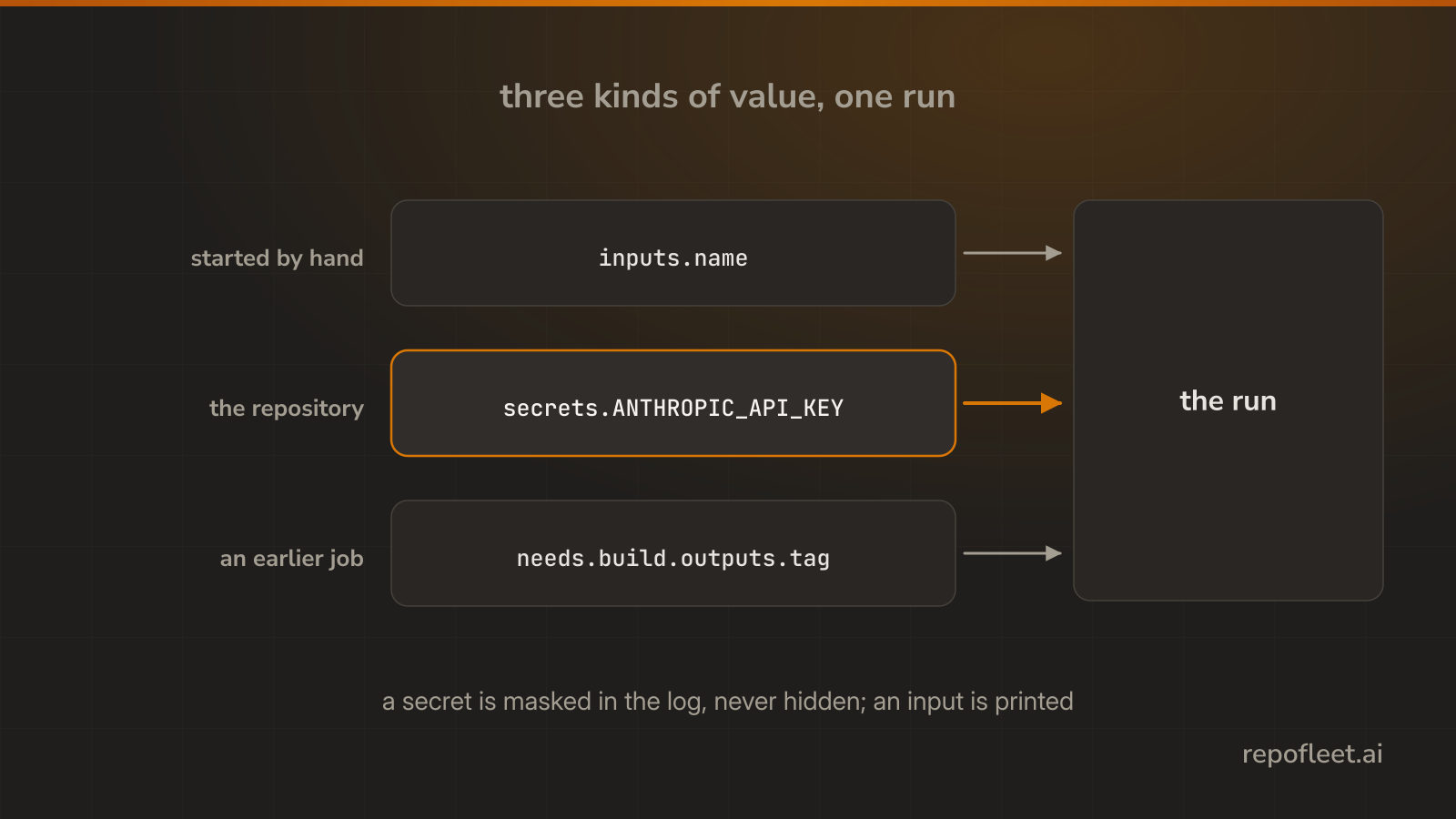
workflow_dispatchdeclares inputs, each with a type and a default, and Start a run offers them as fields.- Reading one is
${{ inputs.name }}, anywhere in the job. - A step writes an output, the job declares it, and a later job reads
${{ needs.build.outputs.tag }}. - The reading job must name the other in
needs, or the value arrives empty and nothing says why.
Rules that catch people
- A secret is masked in the log, not hidden. A command that reshapes the value still prints it.
- An input is not a secret. It is printed in the run's own log.
- A pull request from a fork gets no secrets, so a stranger cannot run an agent that needs the key.
- A secret is never read back. Once saved on GitHub, only a run can use it.